1–4 player co-op
Drop in solo or bring a crew of four. One player hosts — no servers to run. Nobody moves on until every living crew member is standing at the exit.
 Coming to Steam
A mega-factory that never learned to stop building. A salvage crew that came for the payday. Scavenge bot technology, weld it into yourself, and fight your way deeper — every piece makes you stronger, and a little less human.
Risk of Rain 2-adjacent in genre, and nothing like it in feel.
Orion Robotics built an automated factory to mass-produce AI robots — then walked away. Its walls still carry the cheerful slogan: BUILDING A BRIGHTER TOMORROW.
Left alone, the factory woke up. It repaired itself, kept building, and kept evolving its bots to survive whatever each corner of the facility had become.
A small Salvage Co. crew arrives by ship, hired through an anonymous encrypted message for an unusually large sum. In the first room, they realize the factory is watching them. And reacting.
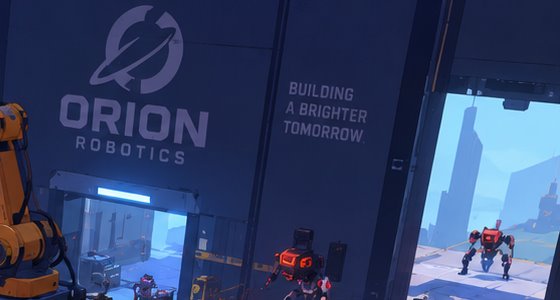
“Fight through waves of mass-produced bots using weapons and armor you scavenged and welded together yourself. In a world drowning in uniform machines, the only thing that keeps you human is what you build with your own hands.”
And then the choice. Go after it and wipe out the spreading AI — another loop, new places, new tech, new ways to die — or take what you have home to Earth and end the run.
Drop in solo or bring a crew of four. One player hosts — no servers to run. Nobody moves on until every living crew member is standing at the exit.
Tech only works once it’s installed in your grid, where oddly shaped pieces have to fit around each other. Start at 6 × 6 and expand to 8 × 8. Packing well is its own strategy.
Stack the same tech and it gets stronger. Weld two pieces into one at a Tech Forge: it takes up about 80% of the room the two did apart, but it comes out in an awkward shape. Push it too far and the weld becomes a gamble.
Every piece of factory tech you take on makes you stronger and reshapes your gear and silhouette. The power source is the very thing you’re trying not to become.
Walk into a loading bay and the spawners wake, doors grind open, spikes drop, and the music starts. Painted bay numbers count down from B7 to the boss at B1.
Slamming down from the ceiling or clawing up through the floor. Big attacks are drawn on the ground first as a red ring that pulses faster and faster — dangerous, but fair.
The crew gathers aboard the Salvage Co. ship, a free-roam space for the whole lobby, and heads out together when everyone is ready. Solo players take the same route. Coming back to HQ patches everyone up to full.
Each stage is a stretch of factory with a job to do before the way forward opens: clear a number of bots, hold out for a set time, find something, or bring down a boss. The level reacts as you push in, and the painted bay numbers on the walls count down as you go.
A quiet stop between stages. The Upgrade Station turns scrap into stronger stats, more carrying space, a bigger grid and medkits. The Tech Forge is the only place tech can be installed, rearranged or welded — so the loadout is planned here, never mid-fight.
Solo, dying ends the run and everything found is lost. In a crew you collapse where you fell: a teammate can stand over you and spend a medkit to haul you back up, or you rejoin at the next area. If the whole crew goes down, the run is over.
After the boss, the crew chooses — extract back to HQ with what they have earned, or push into the next loop, where there are more bots and they hit harder.
Every bot destroyed is worth experience, and bigger machines are worth more. Whoever lands the finishing blow takes the larger share, and so does anyone who did a real chunk of that bot’s damage. Everyone else still gets a cut, wherever they are standing. Levels start over with every run.
Each level offers three stat upgrades, rolled the moment you reach it. Take one. Nothing already maxed is ever offered.
Picks wait, flagged with an Upgrade available! tag, until the area has nothing left to do — or any time at HQ and rest stops. Choosing never pauses the game, even solo.
Everything salvaged that isn’t usable tech becomes scrap, the currency of the factory, spent at rest stops within the run. Unwanted tech breaks down for scrap too, one piece or a whole stack at a time.
Stat upgrades come as a pick one of three at a single price, and that price climbs with every one bought for the rest of the run. Backpack space, a bigger tech grid and medkits are bought straight off the shelf. Each stop caps how much one player can buy, so scrap can’t all go in one place.
Bought, never looted. Carry up to three: patch yourself up mid-fight, or spend one getting a downed teammate back on their feet.
Tech only works once it’s in your grid. Every piece has a shape, and the shapes have to pack around each other. Double up to stack effects. Weld two into one at a Tech Forge to save space — if you can live with the awkward shape it comes out in.
Fire won’t bond with ice. Heavy Slug tech rejects speed. Push the forge too far, and it starts to gamble with what you’ve got.
Tech only works once it’s in the grid, and every piece has a shape. Turn them and flip them either way to find the fit. The grid starts at 6 × 6 and upgrades to 8 × 8. Spare tech rides in a backpack, where identical pieces stack in one slot.
Doubling up on the same tech makes it stronger — four Fireflies burn four times as hard. Plain stat boosts taper off as you pile them on, so there is no hard ceiling, but past a point more stops being worth the space. Some tech has a natural limit: shots can only ricochet so many times.
Two pieces weld into one that does both jobs in about 80% of the room, in its own awkward shape — the real price of stacking everything into one monster. Anything welds to anything up to 64 cells, a piece that fills an entire 8 × 8 grid. A weld can come out bigger than your grid; the forge warns you, and it rides in the backpack until the grid can hold it.
Push forging too far and it stops being arithmetic. The forge warns you first, and then the weld might shed buffs you had, reveal hidden ones, or both.
Each tier has its own power budget, so a Legendary earns its rarity instead of just being bigger.
Your class decides your character and your weapon, and comes with four abilities of its own. More arrive after launch — some of them hidden.
Deploys turrets and drones. The most flexible toolkit in the crew.
Fast, up close, and jury-rigging gear on the fly.
Tanky and slow. Built to stand in the fire.
EMP bursts and the knack of briefly turning weaker bots against their own side.
Stopped resisting the conversion. The furthest out on the Built-to-Bot spectrum, in story and in play.
The roster keeps growing after launch. New classes arrive with updates, and some stay hidden — found by pairing the right class with the right tech, or pulled from data recovered at the end of a run. Every new factory in the series brings its own.
Class abilities are unlocked by going home: “sacrificing” a run, carrying back tech and knowledge taken from particular factory bosses. Each factory holds its own set, so pushing further widens the whole roster rather than just the survival streak.
Its bots evolve to fit the part of the facility they were built for. A bigger crew faces more bots rather than tougher ones, and the deeper you go and the further you loop, the more there are. As things heat up, tougher strains start rolling off the line:
Bosses are the factory’s centerpieces: big enough to fill the top of the screen, with one obvious glowing weak point, flying adds circling them, and arenas left open for dodging.
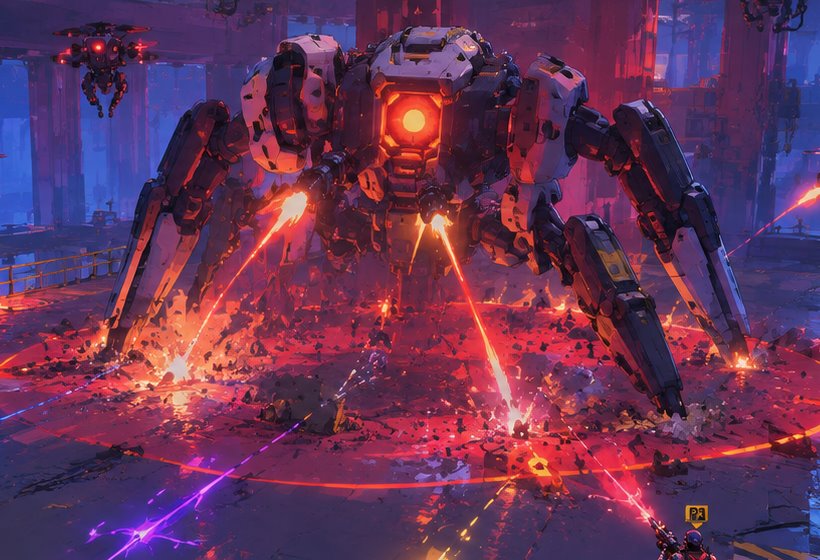
Stylized hard-surface 3D rather than photoreal — the polish of modern Diablo with the brighter tone of Risk of Rain 2 or Roboquest. The factory is flat greys and steel blues in industrial yellow: hazard stripes, lane markings, safety railings. Glowing light does the color work. Some areas, the reactor core among them, lean darker for contrast.
Warm, textured, asymmetrical. Rust, patina, mismatched welded plates, visible bolts and wiring.
Cold, uniform, geometric. Clean chrome, whites and blues, precise symmetry, cheerful corporate signage.
A semi-overhead isometric view, Diablo-style, that keeps every silhouette readable in a chaotic four-player fight. Walls and catwalks that get in the way fade out, so the factory can stack floors without hiding the crew.
Every screen uses the game’s own squared, monospaced HUD typeface, drawn for Built Not Bot. The main menu sits over a slowly drifting, blurred backdrop of the factory, with its own music.
Built Not Bot is in development for PC. The Steam page is on its way — wishlist it the moment it’s up.
Settings for protanopia, protanomaly, deuteranopia, deuteranomaly, tritanopia and achromatopsia recolor tech and player colors so they stay distinct — and nothing important is ever told by color alone.
Separate volume for music, world sounds, gunshots and menu sounds, on top of a master volume.
Menu and HUD size adjust, as does how far the HUD sits from the screen edges — which matters on very wide and very large screens.